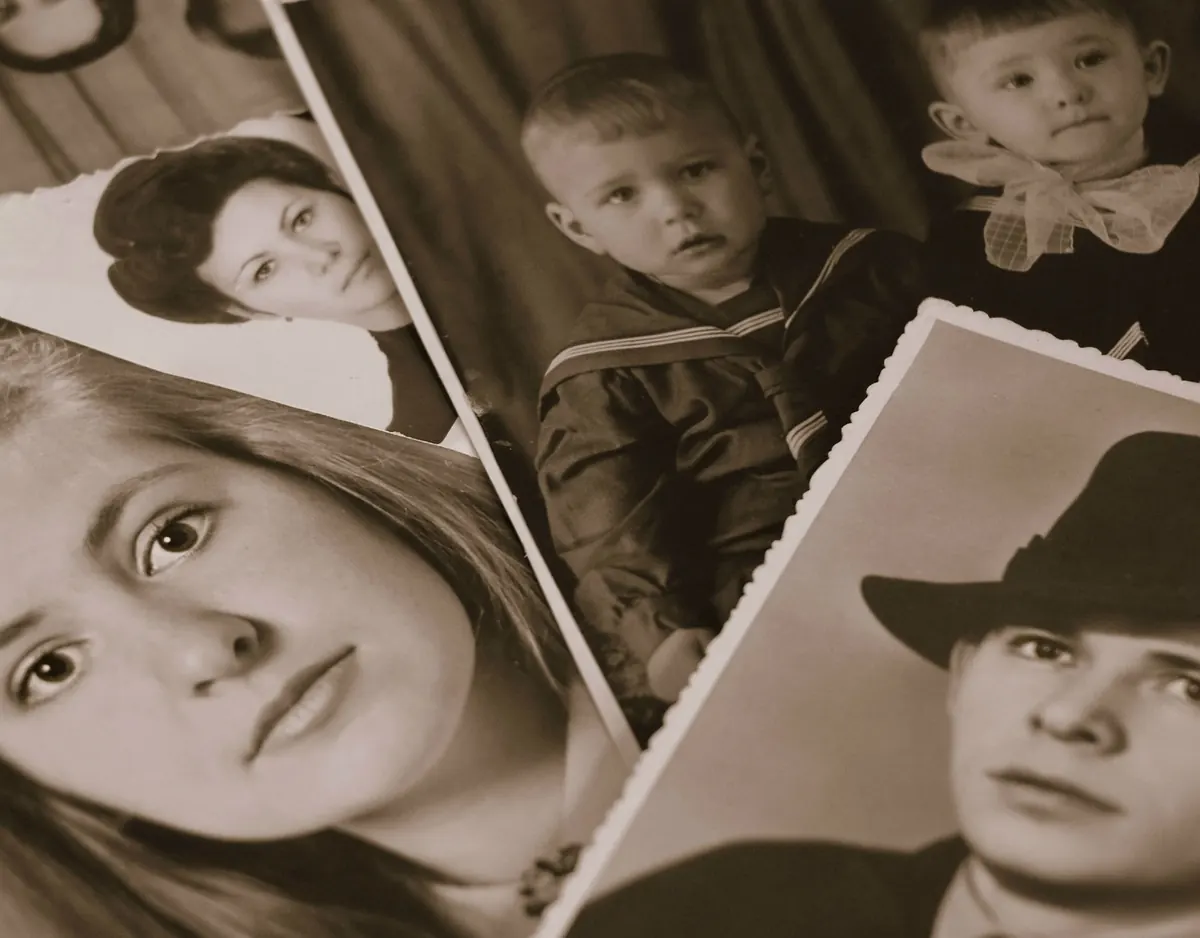
Somewhere in a drawer there is a photograph you keep meaning to do something with. Four people at a table, a child on a bicycle, your grandmother standing in a doorway holding an object nobody can identify anymore. The picture itself is sharp enough. What's missing is everything around it: the heat of that afternoon, the argument before lunch, the reason everyone is squinting into the sun. A one-page memory story is the shortest honest way to put all of that back. It takes an evening, a single page, and the willingness to guess at what the frame cut off.
Look at the Photograph for Ten Minutes Before You Write a Word
The temptation is to start typing the story you already know. Resist it for ten minutes. Put the photo on the table, or open it large on a screen, and take an inventory as if you were cataloguing it for someone else.
Start at the edges. What is happening in the background that nobody posed for? A coat on a chair, a dog half out of frame, a calendar on the wall with a month you can still read. Look at the light: is it coming from a window, from a bulb overhead, from a low sun that makes everyone squint? Then ask the question most people skip — who is holding the camera, and what did that person's absence do to the composition? Someone had to step back to fit everyone in. That person belongs in the story too.
Write down fifteen details in a list. Do not judge them. Half will be useful and half will be filler, and you will not know which is which until the draft is done.
Build the Setting from Three Details, Not Ten
A short story cannot carry everything, so choose three anchors: the ground underfoot, the quality of the light, and one sound or smell that belongs to that day and no other.
Three good details will do more work than a paragraph of description. If the floor was cold terrazzo, say so, and let the reader feel the child's bare feet on it. If the kitchen smelled of onions and hot metal, that single line places us in a specific room in a specific decade without any explaining. If a radio was playing in the next room, the reader will hear it.
Be suspicious of adjectives like lovely, warm and happy. They tell the reader what to feel and give away nothing. Replace each one with a fact the eye could have caught. Instead of "a happy lunch", write "the table was crowded with too many plates and everyone kept reaching across each other."
Give Every Person in the Frame One Gesture, Then Leave One of Them Unexplained
In a photograph, everyone is frozen. In the story, they need to be moving, even slightly. Give each person a single physical action, and make it specific: not "my uncle was laughing" but "my uncle held his fork mid-air while he laughed, and a piece of bread fell onto his lap." One gesture per person is enough. Two is usually too many.
Keep a little mystery
Resist the urge to explain every face. The aunt at the end of the table with her mouth half-open — leave her half-open. If you remember what she was about to say, use it. If you don't, let the reader feel the gap. Uncertainty is not a flaw in a memory story; it is the texture of memory itself, and it makes the page feel honest rather than polished.
A reader trusts a narrator who admits to forgetting. A narrator who remembers everything, perfectly and in order, sounds like a brochure.
Add What the Camera Could Not Record
This is where the story leaves the photograph behind and becomes something worth reading. Work through the senses deliberately rather than waiting for inspiration:
- Sound: What was the loudest thing in the room? What was the background noise nobody noticed at the time?
- Temperature: Was it hot enough to open the windows, cold enough that someone kept the coat on indoors?
- Smell: Cooking, cleaning products, tobacco, damp wool, a particular soap.
- Texture: The tablecloth, a sleeve, a handshake, the handle of a bicycle.
- Taste: Food if there was food — and be specific about it. Not "a good meal" but "the bitter edge of the coffee at the end."
Choose two or three from that list, not all five. A page crowded with sensation reads like an exercise. A page with two well-chosen details reads like a memory.
Find the Small Tension Underneath the Scene
A memory story does not need a crisis. It needs a slight pull, something that was in the air while the photograph was being taken. Someone was about to leave. A meal was running late. A jacket had been borrowed without asking. One person had received news the others didn't have yet.
You do not have to resolve it. In fact, a one-page story usually works better when it doesn't. The tension gives the scene a direction, and the reader supplies the rest. If you can name what everyone was quietly waiting for, you have found the spine of your page.
Draft It in One Sitting, Without Correcting Anything
Give yourself forty minutes and no interruptions. The draft is not the finished piece; it is raw material with a beginning and an end.
- Write one sentence of context. Who is in the photo, where, roughly when — no more than a line.
- Describe the moment the shutter clicked. Put the scene in the present tense if it helps you stay inside it.
- Step forward and backward in time. Two sentences before the photograph, two sentences after it. What happened ten minutes earlier, and what happened when everyone stood up?
- Close on an image, not a summary. The empty chairs, the door left open, the bicycle still lying on the grass.
- Stop before you want to. A page that ends slightly early leaves the reader with room.
Shape It Down to One Page
Wait an hour, ideally a day, then revise with a checklist rather than a mood:
- Cut the first sentence if it exists only to warm up. Most drafts start two lines too early.
- Delete every adjective you could replace with a concrete detail.
- Check the tense. Shifts are allowed, but they should be deliberate.
- Make sure at least one detail could only belong to this scene and nowhere else.
- Read it aloud. Anywhere you stumble, a reader will stumble too.
- Count the words. One page is roughly 500 to 650 words. If you are at 900, you have two stories or one indulgent paragraph.
Keep the Photograph Beside the Page
When the story is done, print it or save it, and attach a note saying which photograph it came from — the date if you know it, the names if you're sure, and a question mark where you aren't. That small act of labelling is worth as much as the story. Future readers will want to know what they are looking at.
Then choose the next photograph, the one with the awkward framing and the person half out of shot. Those make the best pages. Write it in an evening, read it to someone in the family, and correct whatever they insist you got wrong — they are probably right, and the correction is a memory too.
Photo: junko / Pixabay